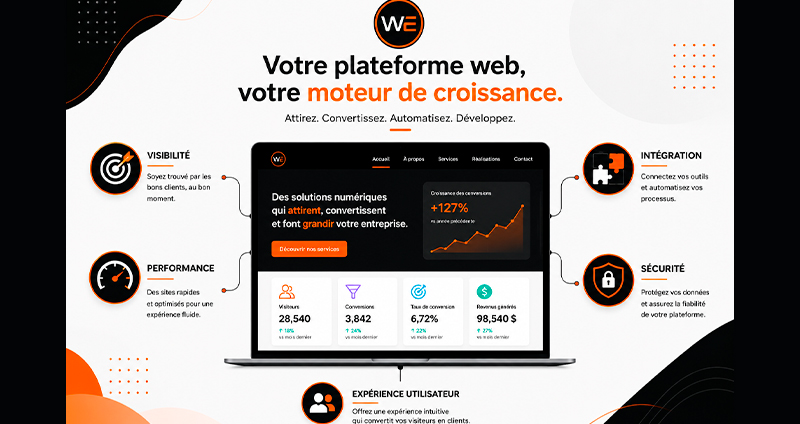

Website Redesign in Quebec in 2026: 10 Signs It's Time to Act
Your website was built three, five, or even ten years ago. At the time, it met your needs. But the web evolves fast — very fast. Visitor expectations have changed, Google updates its algorithms several times a year, and your competitors are investing in their digital presence.
According to a Stanford study, 75% of internet users judge a company's credibility based on its website design. And Google confirms that 53% of mobile visitors leave a page that takes more than 3 seconds to load.
If your site is slow, poorly adapted to mobile devices, or visually outdated, you're losing potential customers every day — without even knowing it.
This guide is intended for Quebec SME leaders who are wondering whether their website still has what it takes to perform. You'll find 10 concrete warning signs, an overview of realistic costs, the steps to a successful redesign, and the mistakes to absolutely avoid.
What Is a Website Redesign (and What Is It Not)?
First, let's clear up a common misconception. A website redesign is not simply a color change or adding a page. It's a thorough reconstruction that involves the technical structure, design, content, and conversion strategy all at once.
Full redesign: you start from scratch (or nearly). New architecture, new design, new code, rewritten content. This is the right choice when the site is more than 4–5 years old or built on obsolete technology.
Refresh (partial redesign): you keep the existing structure and code but modernize the visual appearance, update the content, and fix identified technical issues. Appropriate when the site is relatively recent but lacks polish.
Continuous optimization: regular adjustments based on data (A/B testing, conversion rate improvement, content additions). This is best practice between two major redesigns.
The distinction matters because it directly impacts the budget, timelines, and expected results.
10 Signs It's Time to Redesign Your Website
1. Your Site Is Not Mobile-Friendly
In 2026, over 65% of web traffic in Canada comes from mobile devices. Google has been using mobile-first indexing since 2021: it's the mobile version of your site that determines your search engine ranking. A site that isn't responsive — or whose mobile version is a degraded version of the desktop — loses positions on Google and drives visitors away.
Quick test: open your site on your phone. Is the text readable without zooming? Are the buttons large enough to tap with your thumb? Is the menu functional? If you answer no to any of these questions, a redesign is a priority.
2. Load Time Exceeds 3 Seconds
Speed is a confirmed ranking factor by Google (Core Web Vitals). Each additional second of loading time reduces conversions by 7% on average. For Quebec SMEs whose site needs to convince quickly, this is a major handicap.
Free tools to check: Google PageSpeed Insights (pagespeed.web.dev), GTmetrix, or the Core Web Vitals report in Google Search Console. A mobile score below 50 is a clear warning sign.
3. Your Bounce Rate Is Through the Roof
A bounce rate above 70% on your main pages indicates a serious problem. Visitors arrive and leave immediately without interacting. This can mean the content doesn't match their search, the design doesn't inspire trust, or the navigation is confusing.
Check Google Analytics to identify the most problematic pages. If the issue is widespread (and not limited to one or two pages), the entire site needs to be rethought.
4. Your Site Doesn't Generate Leads or Contact Requests
This is perhaps the most important signal. A business website that generates no calls, emails, or quote requests is not fulfilling its mission. The reasons are often combined: no visible call to action, buried contact form, unclear value proposition, poorly structured customer journey.
A redesign focused on conversion and commercial performance can transform a showcase site into a true business development tool.
5. The Design Is More Than 3–4 Years Old
Web visual trends evolve quickly. A site that looked modern in 2022 can now give the impression that your business is falling behind. Visitors, consciously or not, associate an outdated design with a company that isn't evolving.
In 2026, standards include bold typography, micro-animations, dark mode, clean interfaces, and generous white space. If your site still uses cluttered carousels, background textures, or clipart icons, the contrast with your competitors works against you. An up-to-date graphic design and visual identity instantly strengthens your credibility.
6. Your Site Is Not Compliant with Law 25
Since September 2023, Law 25 (Act respecting the protection of personal information) imposes strict obligations on Quebec businesses: accessible privacy policy, explicit consent for cookies, personal information access request form, and designation of a data protection officer.
A site that doesn't meet these requirements exposes your business to fines of up to $25 million or 4% of global revenue. Beyond the legal aspect, a well-integrated cookie banner strengthens visitor trust. If your site has never been updated for Law 25, a redesign is the perfect opportunity to comply.
7. Your Content Is Outdated or Duplicated
Service descriptions dating from 2020, an "About" page that no longer reflects your reality, blog posts never updated — all of this sends a bad signal to visitors and Google. Duplicate content (the same blocks of text copied across multiple pages) dilutes your SEO authority and can even penalize your ranking.
A redesign is the opportunity to start fresh with a conversion-oriented content strategy — copy designed to answer your potential customers' questions and guide them toward action.
8. You Can't Edit Your Site Yourself
If every small change (updating a phone number, adding a photo, publishing a post) requires contacting a developer and waiting days, your site is slowing down your business agility. A modern CMS (such as WordPress, Laravel, or a custom platform) with an intuitive back-office gives you back control over your content.
During a redesign, insist on having a simple administration system that your team can use without extensive technical training.
9. Your Competitors Are Outranking You Online
Try this: search for your main services on Google (for example, "your service + your city"). If your competitors consistently appear before you, their site is better optimized for search engine optimization (SEO). A redesign that integrates an SEO strategy from the ground up — site architecture, internal linking, optimized tags, local Google visibility — can turn the situation around.
10. Your Site Uses Obsolete or Vulnerable Technology
Flash, PHP 5, WordPress plugins unmaintained for years, a missing SSL certificate — all of these are security risks and compatibility issues. Google flags unsecured sites (without HTTPS) with a "Not Secure" warning that drives away 85% of visitors. A modern web infrastructure ensures the performance, security, and longevity of your investment.
Quick Self-Assessment: Does Your Site Need a Redesign?
Use this grid to evaluate your situation. Give yourself 1 point for each "yes":
| Criteria | Yes | No |
|---|---|---|
| My site doesn't display properly on mobile | ☐ | ☐ |
| Loading takes more than 3 seconds | ☐ | ☐ |
| The design is more than 3 years old | ☐ | ☐ |
| I don't receive inquiries through the site | ☐ | ☐ |
| My bounce rate exceeds 70% | ☐ | ☐ |
| The site is not compliant with Law 25 | ☐ | ☐ |
| I can't edit the content myself | ☐ | ☐ |
| My competitors outrank me on Google | ☐ | ☐ |
| The content is outdated or duplicated | ☐ | ☐ |
| The site uses outdated technology | ☐ | ☐ |
Interpretation:
0–2 points: Your site is in good shape. Focus on continuous optimization.
3–5 points: A refresh is in order. Prioritize the identified weak points.
6–8 points: A redesign is recommended in the short term.
9–10 points: A redesign is urgent — your site is actively holding back your growth.
How Much Does a Website Redesign Cost in Quebec in 2026?
The budget question is legitimate and deserves a transparent answer. Prices vary considerably depending on the scope of the project, but here are realistic ranges for the Quebec market:
| Project Type | Price Range | What's Included |
|---|---|---|
| Showcase site (5–10 pages) | $3,000 — $8,000 | Custom design, responsive, basic SEO, contact form |
| Corporate site (10–25 pages) | $8,000 — $20,000 | Content strategy, blog, integrated CRM, conversion optimization |
| E-commerce site | $15,000 — $50,000+ | Product catalog, online payment, inventory management, advanced SEO |
| Custom web application | $25,000 — $100,000+ | Complex features, client portal, automation, integrations |
Important: beware of offers that seem too low. A $500 website will be a generic template with no SEO optimization, no content strategy, and no support. It's an investment that yields nothing. Conversely, the most expensive site isn't always the best — what matters is choosing a partner who understands your business goals and measures results.
The 6 Steps to a Successful Website Redesign
Step 1: Audit of the Existing Site
Before building, we analyze. A comprehensive performance audit of your current site identifies what works (to keep), what doesn't (to redo), and missed opportunities. This includes analysis of traffic, conversions, SEO, speed, and user experience.
Step 2: Strategy and Goal Definition
What is the primary goal of the new site? Generate leads? Sell online? Inform? The answer guides all the decisions that follow — architecture, content, design, features. Without a clear objective, a redesign is a shot in the dark.
Step 3: Information Architecture and Wireframes
We map out the site structure (which pages, how they connect to each other), then create wireframes and an optimized page structure and customer journey designed for conversion. It's the blueprint before laying the first brick.
Step 4: Design and Development
The visual design brings the wireframes to life, then developers code the site. The best agencies work iteratively — you see the site take shape and can provide feedback along the way rather than only at the very end.
Step 5: SEO Migration and Redirects
This is the step too many agencies neglect — and it's the most dangerous for your visibility. If URLs change (and they almost always do), every old URL must be redirected (301) to the new one. Without this, you lose all the search rankings built up over the years. An SEO migration plan also includes transferring tags, metadata, and structured data.
Step 6: Launch, Monitoring, and Optimization
Launch is not the end — it's the beginning. Performance and conversion tracking in the weeks and months following launch allows you to quickly identify what's working and what needs adjustment. The best results come from continuous optimization based on real data.
The 5 Most Common Mistakes During a Redesign
1. Neglecting SEO migration. Your old site had accumulated authority. Without 301 redirects, you start from zero on Google. This is the most costly and most frequent mistake.
2. Focusing only on appearance. A beautiful site that doesn't convert is a wasted investment. Design must serve the strategy, not the other way around.
3. Ignoring mobile. Designing for desktop first and "adapting to mobile later" always produces a mediocre result on phones. In 2026, we design mobile-first.
4. Copying content from the old site. A redesign is the opportunity to rewrite your copy with a fresh perspective, oriented toward your customers' current needs and optimized for SEO.
5. Choosing the cheapest provider. A website is a business investment. Compare portfolios, ask for references, and verify that the agency understands your industry and your goals — not just that they offer the lowest price.
Redesign and AI Visibility: A 2026 Priority
With the rise of Google AI Overviews, ChatGPT, and Perplexity, your site must now be visible not only in traditional Google results but also in answers generated by artificial intelligence. This is known as GEO (Generative Engine Optimization) and AEO (Answer Engine Optimization).
A redesign in 2026 must address these new challenges: structured data (Schema.org), content in question-and-answer format, citable sources, and topical authority. It's a competitive advantage that most Quebec SMEs are not yet leveraging. Discover our approach to visibility in AI-generated answers.
Frequently Asked Questions About Website Redesign
How long does a website redesign take?
For an SME showcase site, expect 6 to 12 weeks. A complex corporate site or e-commerce platform can take 3 to 6 months. Timelines depend mainly on how quickly the client validates content and wireframes — that's often the bottleneck.
Will I lose my Google rankings during the redesign?
Not if the SEO migration is done correctly. 301 redirects, metadata transfer, and internal linking preserve your rankings. It's normal to see slight fluctuations in the 2–4 weeks following launch, but a well-migrated site recovers quickly and ends up surpassing its previous positions.
Can I do the redesign in phases?
Yes, and it's often recommended for large sites. You can start with the most critical pages (home, services, contact), then redesign secondary pages progressively. This reduces risk and allows you to measure results at each stage.
WordPress, custom-built, or Wix — which CMS should I choose for the redesign?
There's no universal answer. WordPress suits the majority of showcase and corporate sites (70% of the market). A custom solution (Laravel, for example) is preferable for complex needs (client portals, business applications, multiple integrations). Wix and Squarespace may work for a solopreneur on a very tight budget but offer limited SEO flexibility and customization in the medium term.
My site still works — why invest in a redesign?
A site that "works" technically can still underperform. If it doesn't generate leads, if it's slow, if it doesn't appear on Google for your target keywords, it's costing you in missed opportunities every month. The cost of inaction is often greater than the cost of the redesign.
Ready to Breathe New Life into Your Online Presence?
At Web Experts, we've been helping Quebec SMEs redesign their websites for over 10 years. Our approach combines business strategy, modern design, robust development, and search engine optimization — for a site that doesn't just look good but delivers measurable results.
Request your free audit and discover what a redesign can concretely bring to your business.